
SWING – School on Internet Governance 2026
SWING – School on Internet Governance 2026 will take place in Bruges, Belgium, from 20 to 24 April 2026. Hosted by the United Nations University Institute on Comparative Regional Integration Studies (UNU-CRIS), SWING is designed for graduate students, early-career researchers, ICT professionals, policymakers, and anyone interested in the field. The program aims to strengthen participants’ understanding of the actors, processes, and policy challenges, shaping the governance of the internet and digital technologies. Through a combination of expert-led lectures and interactive group work, participants collaboratively analyse key governance issues and develop policy recommendations to be presented during the program’s final sessions.
How to Apply
To apply, please see the call and registration form.


SWING 2026 Theme: Digital Sovereignty
The 2026 edition will focus on Digital Sovereignty — a timely and fast-evolving concept at the crossroads of Internet governance, geopolitics, economics, innovation, and fundamental rights. Broadly speaking, digital sovereignty concerns the ability of states, regions, organisations, communities, and individuals to make autonomous choices in the digital sphere: how data is generated, stored, accessed, and governed; how critical infrastructures are built, secured, and maintained; how strategic technologies are developed and regulated; and how dependencies on external actors are managed.
Across the week, participants will examine digital sovereignty both as a policy objective (resilience, security, competitiveness, strategic autonomy) and as a normative challenge (openness and interoperability of the Internet, human rights protections, inclusive governance, and international cooperation). Particular attention will be devoted to concrete domains where sovereignty claims are most visible — from cybersecurity and AI to semiconductors, undersea cables, and satellite infrastructures — and to the trade-offs that emerge between protection, innovation, and openness.
Lectures and seminars will be delivered by internationally renowned scholars and experts, combining academic depth with policy relevance and practical insight. The programme also includes interactive group work throughout the week, culminating in policy recommendations presented during the final sessions.
Core Seminars and Lectures
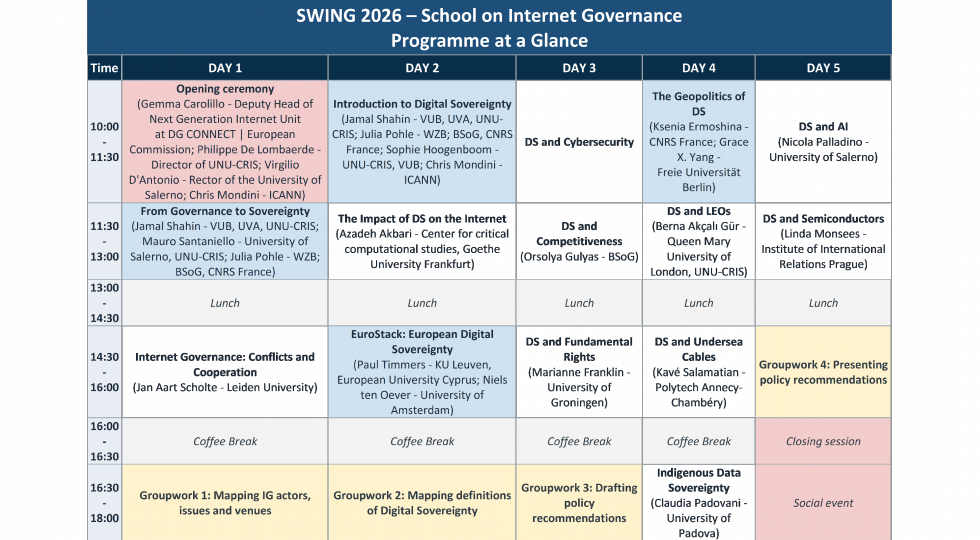
Introduction to Digital Sovereignty (seminar)
Jamal Shahin - VUB, UVA, UNU-CRIS; Julia Pohle - WZB; Sophie Hoogenboom - UNU-CRIS, VUB; Chris Mondini - ICANN
From Governance to Sovereignty (seminar)
Jamal Shahin - VUB, UVA, UNU-CRIS; Mauro Santaniello - University of Salerno, UNU-CRIS; Julia Pohle - WZB, BSoG, CNRS France
The Impact of Digital Sovereignty on the Internet
Azadeh Akbari - Center for Critical Computational Studies, Goethe University Frankfurt.
EuroStack: European Digital Sovereignty (seminar)
Paul Timmers - European University Cyprus, KU Leuven; Niels ten Oever - University of Amsterdam.
Digital Sovereignty and Competitiveness
Orsolya Gulyas - Brussels School of Governance (BSoG).
Digital Sovereignty and Fundamental Rights
Marianne Franklin - University of Groningen.
Indigenous Data Sovereignty
Claudia Padovani - University of Padova.
Digital Sovereignty and Undersea Cables
Kavé Salamatian - Polytech Annecy-Chambéry.
Digital Sovereignty and Semiconductors
Linda Monsees - Institute of International Relations Prague.
Digital Sovereignty and Artificial Intelligence
Nicola Palladino - University of Salerno.
Digital Sovereignty and LEOs (Low Earth Orbit satellites)
Berna Akçalı Gür - Queen Mary University of London, UNU-CRIS.
Internet Governance: Conflicts and Cooperation
Jan Aart Scholte - Leiden University.
The Geopolitics of Digital Sovereignty (seminar)
Kseniia Ermoshina - CNRS, France; Grace X. Yang - Freie Universität Berlin
Lecturer(s) to be confirmed for the following sessions:
Digital Sovereignty and Cybersecurity
In addition to lectures and seminars, the programme features structured group work across the week: mapping key Internet governance actors, issues and venues; mapping definitions and approaches to digital sovereignty; drafting policy recommendations; and presenting them in the closing segment. Networking moments and dedicated multistakeholder discussion spaces will complement the academic programme.
Key Dates
13 March 2026 — Application deadline, including fee payment
20–24 April 2026 — SWING 2026 (Bruges, UNU-CRIS)
Registration
To register, applicants will be asked to submit:
- Curriculum Vitae (CV)
- Completed application/registration form (template/model)
- Copy of a valid ID document (passport or national identity card)
- Proof of payment of the participation fee (receipt/confirmation)
Participation Fee and What It Covers
The participation fee is 800,00 € and includes:
- Registration costs
- Meals provided during the School programme
- Social event(s)
The participation fee does not include:
- Accommodation
- Although students are required to provide for their own accommodation, SWING has an agreement with a local hotel that is willing to provide a reduced fare for the students of the school. Details will be provided after a successful registration.
- Dinners
Participation Fee Payment
Registration is completed once the participation fee has been paid and the required documentation has been submitted. Applicants should include proof of payment (receipt/confirmation) with their registration materials. Detailed payment instructions — including the fee amount, payment method, bank details/IBAN, payment reference, and deadlines are communicated in the official registration form.
Scientific Committee
Co-directors: Mauro Santaniello (University of Salerno, UNU-CRIS) and Jamal Shahin (VUB, UVA, UNU-CRIS).
Scientific Advisory Board: Andrea Beccalli (ICANN), Dennis Broeders (Leiden University), Edoardo Celeste (Dublin City University), Philippe De Lombaerde (UNU-CRIS), Sophie Hoogenboom (UNU-CRIS, VUB), Robin Mansell (London School of Economics), Francesca Musiani (CNRS), Nicola Palladino (University of Salerno), Dennis Redeker (University of Bremen) and Riccardo Nanni (CNRS).
Organizing Committee: Sophie Hoogenboom (UNU-CRIS, VUB), Carlos Andres Fonseca Diaz (Ghent University, UNU-CRIS), Armando Antonio Ferrara (University of Salerno), Chiara Spiniello (University of Salerno) and Stephanie Teeuwen (VUB).
Programme
For further information about the School and registration, please contact Sophie Hoogenboom at shoogenboom@cris.unu.edu
Similar Events
No events found.